
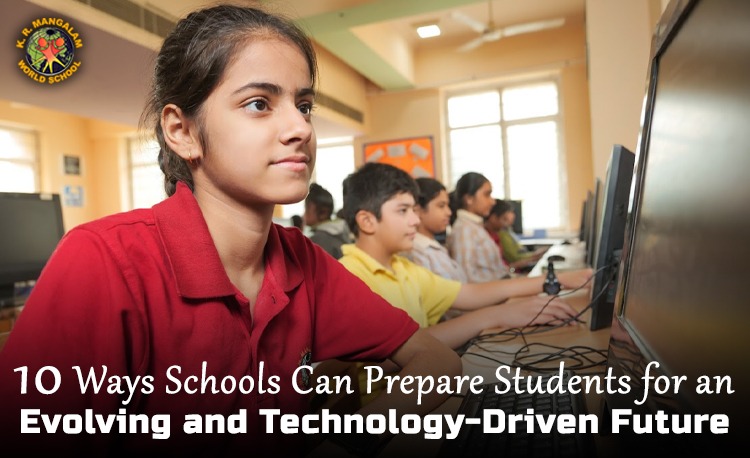
Key Highlights
- Future-ready education should focus on skills as well as academic knowledge.
- Technology should support meaningful learning rather than replace teachers.
- Critical thinking and problem-solving can help students navigate uncertainty.
- Creativity and collaboration are essential in a rapidly changing world.
- Experiential learning can connect classroom concepts with real situations.
Introduction
The future of education is being shaped by rapid technological advancement, changing workplaces and new ways of communicating and accessing information. At KR Mangalam World School GK 2, artificial intelligence, automation, digital platforms and emerging technologies are transforming how people learn and work. As a result, students need preparation that goes beyond memorising information for examinations.
For parents exploring Top 10 Schools in South Delhi, future readiness can therefore be an important factor when evaluating educational approaches. A strong school should ideally combine academic foundations with creativity, critical thinking, collaboration, technology awareness and life skills.
10 Ways Schools Can Prepare Students for the Future
1. Develop Strong Digital Literacy
Technology is now an integral part of everyday life. Students should understand how to use digital tools effectively, responsibly and safely.
Schools can introduce age-appropriate digital learning while teaching students about online privacy, responsible communication, information credibility and ethical technology use. The objective should not simply be to make children familiar with devices but to help them become thoughtful digital users.
2. Strengthen Critical Thinking
Technology provides access to enormous amounts of information, but access does not automatically mean understanding.
Students should learn to question information, identify reliable sources, compare viewpoints and form evidence-based conclusions. Classroom discussions, research activities and problem-solving exercises can help develop these abilities.
Critical thinking becomes particularly important when students encounter AI-generated or digitally produced information and need to assess its accuracy and relevance.
3. Encourage Creativity and Innovation
Future challenges may not always have predetermined solutions. Creativity can help students approach unfamiliar situations with curiosity and imagination.
Art, design, writing, experimentation, project work and interdisciplinary activities can provide opportunities for students to generate ideas and test possibilities.
A future-ready educational approach should therefore encourage children to ask, “What else could be possible?” rather than focusing only on finding one correct answer.
4. Make Learning Experiential
Students often understand concepts more effectively when they can connect them with practical situations.
Experiments, projects, field experiences, simulations and hands-on activities can transform abstract concepts into meaningful learning experiences. They also allow students to practise planning, observation, analysis and reflection.
The published educational approach associated with the institution places emphasis on experiential learning, joyful learning, competency-based learning and 21st-century skills, reflecting the importance of connecting education with practical abilities.
5. Build Collaboration Skills
Technology has made it possible for people in different locations and cultures to work together. Students therefore need to understand how to communicate, share responsibilities and contribute to teams.
Group projects, peer learning, classroom discussions and collaborative problem-solving can help children develop these abilities.
Collaboration also teaches students to appreciate different perspectives instead of assuming that their own approach is always the best one.
Conclusion
The future cannot be predicted with complete certainty, but education can prepare students to face uncertainty with confidence.
At KR Mangalam World School GK 2, the schools can contribute by developing digital literacy, critical thinking, creativity, collaboration, communication, leadership and emotional intelligence. Experiential and competency-based learning can further help students understand how knowledge works beyond textbooks.
For parents comparing Top 10 Schools in South Delhi, the strongest indicator of future readiness may therefore not be the number of technologies available on campus, but how effectively the school uses education to develop capable, ethical and adaptable young people.
FAQs
- What is future-ready education?
Future-ready education combines academic knowledge with digital literacy, critical thinking, creativity, communication, collaboration and adaptability. - Why is digital literacy important for students?
It helps children use technology effectively while understanding online safety, responsible behaviour and the importance of evaluating information. - How does experiential learning prepare students for the future?
It allows students to apply knowledge to practical situations while developing problem-solving, collaboration and decision-making skills. - Why should schools teach life skills?
Life skills help students manage responsibilities, relationships, challenges and changing circumstances more confidently. - Does future-ready education depend only on technology?
No. Technology is one element. Human qualities such as creativity, empathy, communication and critical thinking remain equally important. - How can schools develop lifelong learners?
Schools can encourage curiosity, independent research, reflection, experimentation and a positive attitude towards continuous learning.