
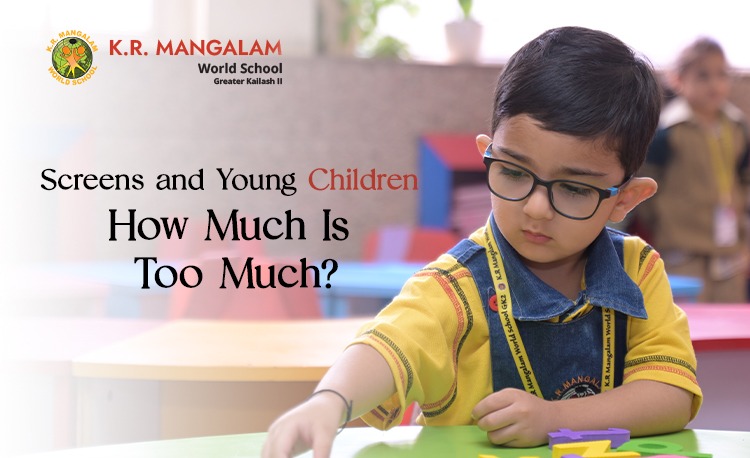
One hour. That is the most sedentary screen time the World Health Organization recommends in a day for children aged 3 to 4, and it adds that less is better.
For many families, that number comes as a surprise. Phones keep children calm in waiting rooms, cartoons buy a few quiet minutes before dinner, and video calls connect children with grandparents in other cities. Screens are useful, and nobody needs to feel guilty for using them. The challenge is that an hour goes by very quickly.
Parents shortlisting the top nursery schools in South Delhi often ask about smart classrooms and digital tools. It is worth asking the opposite question too: how much of a young child’s day is spent away from screens, moving, talking, and making things?
What the WHO Guidelines Actually Say
In 2019, the WHO published its first guidelines on physical activity, sedentary behaviour, and sleep for children under five. For children aged 3 to 4, it recommends:
Ø No more than one hour of sedentary screen time a day; less is better.
Ø At least 180 minutes of varied physical activity a day, including at least 60 minutes of moderate- to vigorous-intensity activity.
Ø 10 to 13 hours of good-quality sleep, including naps, with regular sleep and wake-up times.
Read together, these three points tell a simple story. Young children need to move a lot and sleep well, and too much screen time tends to eat into both.
Where Does the Hour Go?
Screen time often builds up without anyone noticing. A few minutes in the morning, a show after lunch, the phone in the car, and a video before bed can easily add up to well over an hour. Keeping a rough note for two or three days is often an eye-opener.
What Can an Hour Look Like Instead?
If you are looking to cut back, it helps to have ideas ready. In the time a long cartoon takes, a child could:
Ø Build a den with cushions and bedsheets.
Ø Help water plants or sort the vegetables.
Ø Listen to two or three picture books read aloud.
Ø Dance to a few favourite songs.
Ø Play with dough, blocks, or a box of old containers.
Ø Draw a picture and tell you the story behind it.
House Rules That Work
Make the Rules Predictable
Decide when screens are allowed and for how long, and keep it the same each day. A visual timer helps young children see when time is nearly up.
Watch Together
Sitting with your child and chatting about what you see turns passive viewing into conversation.
Turn Off Autoplay
Autoplay removes the natural stopping point between videos. Switching it off makes it easier to end screen time calmly.
Keep Some Times Screen-Free
Meals and the hour before bed are good places to start.
Watch Your Own Habits
Children notice when adults are always on their phones. Putting yours away during family time makes the rules feel fair.
Where School Fits In
Young children spend a good part of their waking hours at school, so the nursery day has a real effect on how much they move, talk, and look at screens. When that day is active and hands-on, there is far less to make up for at home.
At K.R. Mangalam World School, G.K-II, our Pre-Primary curriculum is built around inquiry, exploration, and play-based learning. Children spend their time building, talking, and creating, with long, unhurried blocks of time for each activity. This gives them the back-and-forth conversation and hands-on practice that screens cannot offer.
Movement is part of the week too, and it counts towards the WHO’s recommended 180 minutes of daily physical activity. Indoor and outdoor games are introduced from the Pre-Primary level, and yoga is part of the timetable from Pre-Primary to Class XII. You can read more about our sports programme on our website.
Technology is used across our school, and in the early years it supports hands-on discovery rather than replacing it. If you would like to know how screens are used in our Pre-Primary classes, ask us when you visit. It is exactly the kind of question we hope parents will bring.
Frequently Asked Questions (FAQs)
Q. Do educational apps count as screen time?
Yes. Good-quality content is better than random videos, but it still counts towards the daily limit.
Q. What about video calls with family?
Video calls are interactive and keep children close to relatives, so many parents treat them differently from watching shows. It is still sensible to keep them in balance with other activities.
Q. How do I cut back without daily battles?
Reduce screen time gradually, give a warning before it ends, and have a specific activity ready to move on to. Expect some protest at first, and stay consistent.
Q. Is it too late if my child already watches a lot?
Not at all. Habits can change at any age. Start small, and replace screen time with reading, active play, and time outdoors when the air quality allows.
Q. Should I ask schools about screen use?
Yes. Ask how technology is used in the early years, and how much of the day is given to play, movement, and hands-on learning.
Conclusion: Balance, Not Guilt
An hour a day is a guideline, not a test that parents pass or fail. What matters is that screens stay a small part of a day that is otherwise full of movement, conversation, stories, and good sleep. Home takes care of much of that day, but school shapes a large share of it too.
That is why the questions you ask on school visits matter. As you shortlist the top nursery schools in South Delhi, ask how young children spend their day and how much of it is active, hands-on, and away from screens. We would be happy to answer those questions in person. Call us on +91-9999-046-046 to arrange a visit to K.R. Mangalam World School, G.K-II, and see our Pre-Primary classrooms and sports spaces for yourself.