
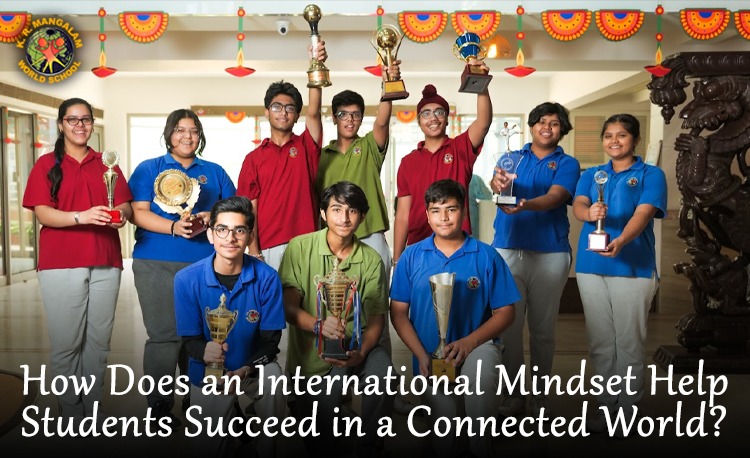
A generation ago, education was designed to help students succeed in their local environments. While it’s still the case, you’ll notice something extra being done: modern schools have started preparing students for a global world, and for all the right reasons. At KR Mangalam World School GK-II, regarded as the best school in South Delhi, we recognise the fact that today’s children are growing up in a world where ideas, technologies, businesses, and people constantly interact across borders, and as such, they must be raised with an international mindset from a young age.
If you look at the current scenario, it is no longer impossible for a student from Delhi, Mumbai, or any Indian city, for that matter, to collaborate on a project with peers abroad, learn from global experts online, and even compete for opportunities alongside candidates from different cultures and backgrounds. However, children can only succeed in such environments if they have a sharp international mindset.
In this blog post today, we will help you understand what an international mindset is and why it matters so much in today’s world. So, make sure you read till the end.
What Exactly is an International Mindset?
Before we proceed, we’d like to clarify what an international mindset precisely means in this context, as different parents view it differently. Some people even mistakenly believe that an international mindset is about preparing children to leave the country or adopt a foreign culture.
In reality, it’s simply about helping children understand that the world is interconnected and that different people may think, communicate, and solve problems differently. At KR Mangalam World School GK-II, one of the top schools in South Delhi, we emphasise instilling an international mindset in students from a young age. This helps ensure that they’re not just curious about other cultures and open to new perspectives but are also respectful of differences and capable of looking at issues from multiple viewpoints. The best part is that over time, children learn all this while remaining grounded in their own identity and values.
In short, an international mindset is simply about being able to think globally while remaining connected to one’s roots.
Does My Child Really Need to Develop an International Mindset?
It’s a question we get asked the most. Many parents assume that an international mindset only matters if a child plans to study or work abroad. In reality, it’s becoming relevant for almost every student. Today’s workplaces, universities, industries, and even social interactions increasingly involve people from different cultures and professional backgrounds.
So, going ahead, whether your child plans to become an entrepreneur, doctor, teacher, engineer, scientist, or join India’s administrative services, they’ll still have to interact with people of diverse backgrounds at some point in their career. Developing an international mindset in children will ensure they not just communicate effectively but also easily adapt to change and understand different perspectives. These skills are highly valuable and will come to their aid in all walks of life.
How Does an International Mindset Help Children Succeed in a Global World?
· Instils in Children the Skills to Work Effectively with Diverse People
Success in the modern world depends highly on how well one can interact and collaborate with people from different backgrounds. International mindedness makes it doable. It teaches children how to respect different viewpoints, communicate thoughtfully, and work productively with people from varied cultural and social backgrounds.
· Strengthens Critical Thinking & Problem-Solving
An international mindset exposes students to diverse viewpoints from around the world. It makes them realise that problems rarely have a single solution. Continued exposure to different perspectives encourages them to analyse situations more deeply, question assumptions, and evaluate multiple approaches before making decisions. It significantly sharpens their critical thinking & problem-solving skills, which eventually contribute to their overall success.
· Builds Empathy, Confidence, and Global Awareness
International mindedness makes children gain first-hand experience of how people live, think, and communicate across cultures. This observation makes students more empathetic and socially aware. It also fosters a distinct confidence in students, enabling them to communicate effectively in diverse academic, professional, and social settings.
How Does KR Mangalam GK-II Help Students Develop an International Mindset?
At KR Mangalam World School GK-II, the leading CBSE and Cambridge school in South Delhi, we integrate global learning opportunities into students’ educational experiences through multiple initiatives. Since we’re one of the few schools in South Delhi that offer dual-curriculum pathways (CBSE + Cambridge), this learning pathway naturally exposes students to diverse international environments.
The activities included in our Cambridge program gradually build an international mindset in students. In addition to the usual classroom activities, we organise events in collaboration with international universities to foster an international mindset among our students.
The Monash Innovation Guarantee (MIG) India 2025 program was one such successful collaboration. We collaborated with Monash University, Australia, for a transformative 3-day program aimed at empowering our students with all the tools needed to develop an international mindset, sharpen their design thinking, and fuel their innovative side to solve real-world challenges. It immensely benefited our students, empowering them to become better global citizens with a sharp international mindset.
Frequently Asked Questions (FAQs)
· Does an international mindset mean my child will become disconnected from Indian values?
No, absolutely not. An international mindset will simply introduce your kids to global perspectives, helping them be aware of the world beyond their immediate environment. They remain connected to their roots throughout.
· At what age should children start developing an international mindset?
The earlier you start developing an international mindset, the better. We usually start introducing kids to an international mindset as they enter the Cambridge primary years at age 5+.
· Can students develop an international mindset without studying abroad?
Yes, they absolutely can. Just enrol them in a school that emphasises developing an international mindset.
Conclusion
The world in which today’s students are growing up is far more connected than any previous generation has experienced. If you want your kids to thrive in this environment, you must instil an international mindset in them from a young age. It will equip them with all the skills, beliefs, and mindset needed to interact and collaborate freely with people from diverse backgrounds, naturally contributing to their success.
At KR Mangalam World School GK-II, positioned among the best schools in South Delhi, we are committed to nurturing globally aware, future-ready learners who are equipped with the skills and confidence to navigate the challenges and opportunities the future brings to them.
If you would like to learn more about how our CBSE and Cambridge pathways help students develop an international outlook, connect with our admissions team or visit our campus.